
What Are Basal Dental Implants?
Basal dental implants are implants designed to anchor in the dense cortical or basal bone of the jaw. Unlike conventional implants, which primarily rely on the available alveolar bone, basal implants are designed to obtain strong mechanical anchorage in deeper, denser bone. This approach may be considered for patients with significant bone loss.
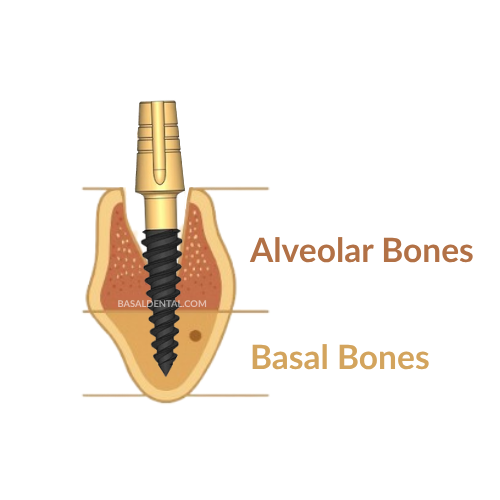
For patients who have lost teeth and bone volume, conventional implant treatment can sometimes involve bone grafting or other preparatory procedures. Basal implantology offers a different treatment approach that may allow fixed teeth with a shorter treatment timeline in selected cases.
Basal dental implants, also called cortical implants or corticobasal implants, are designed to engage dense cortical areas of the jaw.

Cortical bone is generally denser and more resistant to resorption than the alveolar ridge. Basal implantology therefore uses specific implant designs and surgical techniques to obtain stability from these anatomical areas.
The objective is to achieve sufficient primary stability to support a fixed prosthesis, sometimes using an immediate loading protocol.
However, basal implants are not simply conventional implants placed deeper in the jaw. Their design, positioning and prosthetic protocol are different.
How Do Basal Dental Implants Work?
Anchorage in cortical bone
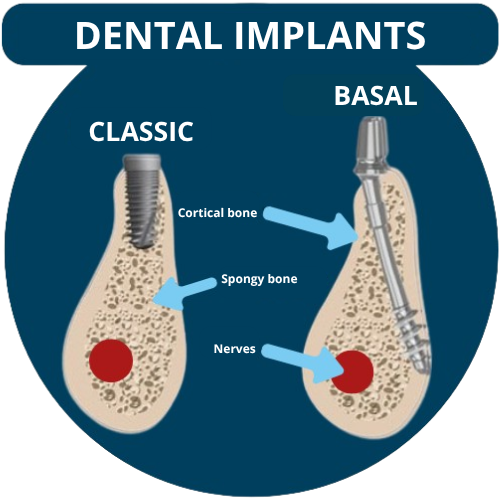
Conventional dental implants are commonly placed in the alveolar/ spongy bone and depend on biological osseointegration during healing.
Basal implants are designed to use dense cortical bone for mechanical anchorage. Depending on the implant system and anatomy, this may involve specific cortical areas of the maxilla or mandible.
Immediate functional loading
One characteristic associated with basal implantology is immediate functional loading.
When adequate primary stability is achieved, the implants can sometimes be connected to a rigid prosthetic construction and loaded immediately or very soon after placement.
Primary stability, bone quality, implant design and prosthetic factors all influence the decision.
Who Can Benefit From Basal Dental Implants?
Basal implants may be considered for patients with complex dental situations, particularly when there has been substantial loss of alveolar bone.
Potential situations include:
- Severe jawbone resorption
- Multiple missing teeth
- Complete tooth loss
- Advanced periodontal disease
- Teeth that cannot be preserved
- Patients seeking fixed full-mouth rehabilitation
- Situations where conventional implant placement is difficult
The important point is that bone loss does not automatically mean that basal implants are the right treatment.
A clinical examination and appropriate imaging are necessary before deciding on an implant treatment.
→ Request a Basal Implant Consultation
Basal Implants and Severe Bone Loss
Severe bone loss can make conventional implant placement more challenging.
In some patients, the available alveolar bone may not provide enough volume or suitable anatomy for conventional implant placement without additional procedures.
Basal implantology takes a different approach by seeking stable anchorage in deeper cortical structures. Clinical literature has described basal implants as an option for rehabilitation in severely atrophic jaws.
This does not mean that every patient with bone loss can avoid augmentation (bone grafting).
The treatment plan depends on the anatomy of the jaw, the condition of the gums, existing teeth, general health and the implant system selected.
Can Basal dental Implants Be Placed Without Bone Grafting?
Yes, in most cases, basal dental implants treatment may be performed without conventional bone grafting.
This is one of the reasons patients with severe bone loss may ask about basal dental implants.
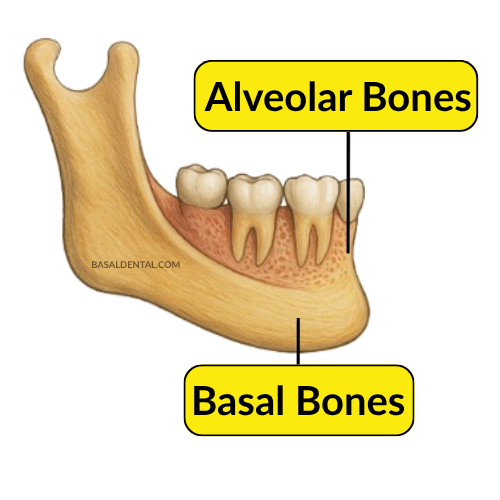
Instead of rebuilding the lost alveolar ridge first, the implantologist may plan the implant position around existing anatomical structures capable of providing mechanical support.
Basal Dental Implants vs Conventional Implants
The main difference concerns where and how the implant obtains its stability.
Conventional implants are generally designed to integrate with the surrounding bone through osseointegration.
Basal implant systems are designed to obtain anchorage in dense cortical bone and are commonly associated with immediate functional loading protocols.
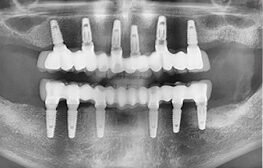
Neither approach should automatically be considered better for every patient.
The appropriate technique depends on factors such as:
- Bone anatomy
- Bone quality
- Number of missing teeth
- Periodontal condition
- Prosthetic requirements
- General health
What Does Basal Implant Treatment Involve?
1. Initial assessment
Treatment starts with an examination and diagnostic imaging.
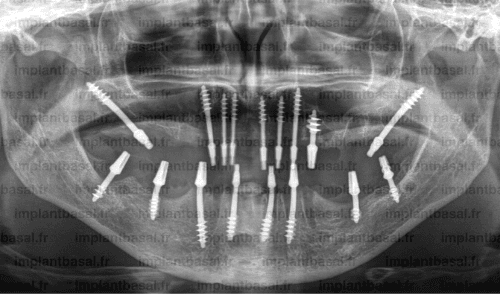
A panoramic X-ray help the clinician assess the jaw anatomy and plan implant placement.

→ Rebuilding Teeth with Basal Implants – Fabien’s Patient Story
2. Treatment planning
The clinician evaluates the available bone and determines which implant positions can provide adequate stability.
The prosthetic design is also an important part of the planning process.
3. Implant placement
The implants are placed according to the planned surgical protocol.
The exact technique varies according to the anatomy and patient’s treatment requirements.
4. Fixed prosthetic rehabilitation
When immediate loading is appropriate, the implants are connected to a fixed prosthetic and definitive construction.
This can allow some patients to receive fixed teeth much sooner than with traditional delayed-loading protocols.

→ Rebuilding Teeth with Basal Implants – Fabien’s Patient Story
How Long Does Basal Implant Treatment Take?
One reason patients investigate basal implantology is the possibility of a shorter treatment timeline.
Basal implant protocols are designed around immediate functional loading, meaning that a fixed prosthesis can be provided shortly after implant placement.
The exact timeline varies between patients.
It depends on the number of teeth involved, extractions, implant positioning, prosthetic preparation and the patient’s individual clinical situation.
→ Request a Basal Implant Consultation
Are Basal Dental Implants Safe?
Basal dental implants are a surgical treatment and, like other dental implants, they have potential risks and complications.
Clinical studies have reported amazing results for the patient recovery after immediate-loading protocols.
Furthermore, basal implantation causes significantly less trauma to the gum and bone than conventional implants, primarily due to its size.
What Are the Advantages of Basal Dental Implants?
Depending on the clinical situation, potential advantages may include:
Fixed teeth in complex cases
Basal implantology may provide an option for patients with significant bone loss who have limited conventional implant options. Fixed teeth with definitive prothesis after 7 days in average for full mouth.
Reduced need for bone augmentation
The treatment can avoid conventional bone grafting procedures for majority of patients.
Shorter treatment time
Immediate functional loading protocols can reduce the period between implant placement and fixed rehabilitation. (7 days)
Full-mouth rehabilitation
Basal implants can be used in treatment plans involving multiple missing teeth or complete-arch rehabilitation.
These potential advantages must always be considered alongside the limitations and risks of the specific treatment.
→ Request a Basal Implant Consultation
What Should You Ask Before Choosing Basal Implants?
Before starting treatment, ask your implantologist:
- Why is basal implantology appropriate for my case?
- When will my fixed teeth be fitted?
- What are the possible complications?
- What happens if an implant fails?
- What follow-up is included after treatment?
- Who will manage the prosthetic treatment?
A transparent consultation should explain both the potential benefits and the limitations of the proposed treatment.
Basal Dental Implants in Bulgaria
Bulgaria is one of the European destinations where international patients can access dental implant treatment.

For patients considering treatment abroad, the decision should not be based on price alone.
It is important to investigate the clinician’s experience, laboratory facilities, treatment protocol, guarantees and arrangements for follow-up after returning home.
A detailed treatment plan should be provided before committing to treatment.

Frequently Asked Questions
What are basal dental implants?
Basal dental implants are implants designed to obtain anchorage from dense cortical or basal bone. They are commonly associated with immediate functional loading protocols and may be considered in cases of significant bone loss.
Are basal implants suitable for severe bone loss?
They may be considered for some patients with severe bone loss because the treatment aims to use deeper cortical bone for implant anchorage. Individual anatomy must be assessed before treatment.


Can basal implants be placed without bone grafting?
Yes. Basal implant treatment may allow implant placement without conventional bone augmentation.
Can basal implants provide fixed teeth immediately?
Yes, basal implant protocols are designed for immediate functional loading. This requires adequate primary stability and an appropriate prosthetic plan.
Are basal implants better than conventional implants?
There is no single implant technique that is best for every patient. Basal and conventional implants use different approaches, and the appropriate treatment depends on the patient’s anatomy, dental condition and treatment objectives.
Conclusion
Basal dental implants offer a different approach to implant rehabilitation, particularly for patients with significant bone loss. By using dense cortical bone for anchorage, selected treatment protocols can provide strong primary stability and, in appropriate cases, allow immediate functional loading.
Considering basal dental implants?
Send us your dental X-rays or existing treatment records to request an initial assessment and discuss the options available for your situation.